Financial Planning and Investment Management Services
My goal is to make sure your money works as hard for you, as you worked to earn it. To that end, I use the tools of financial planning, investment management and risk management to help my clients achieve their goals.
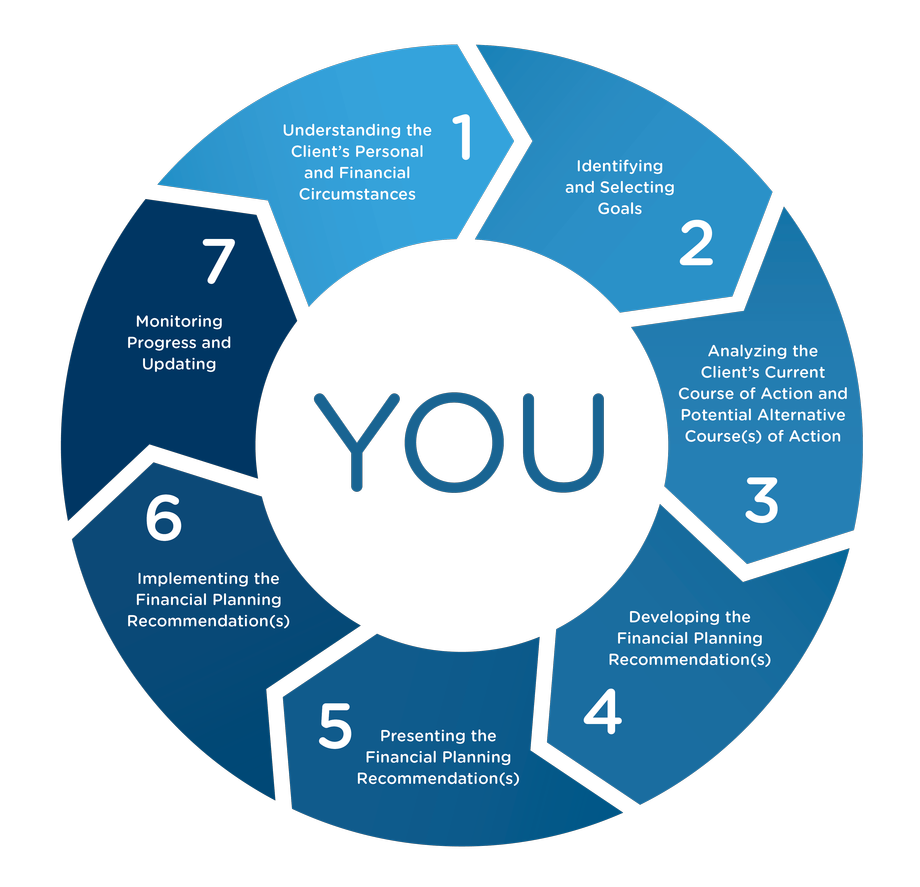
Comprehensive Financial Planning
The core of good financial planning is a comprehensive assessment of your entire financial situation and an integrated plan set up to accomplish your goals. Comprehensive plans intensively review all of the key areas of financial planning which include:
- cash management,
- risk management,
- taxation,
- retirement planning,
- investment management, and
- estate planning.
The result is a plan tailored to your unique financial circumstances. A fee is charged based on a flat hourly rate and will be determined in advance by the complexity of your situation.
Focused Analysis
A detailed analysis of a single issue or issues of any of the key areas of comprehensive planning will be provided. A flat hourly fee will be charged based on the complexity of the analysis.
Retirement Planning
Perhaps the most important issue facing people is how to prepare successfully for the last half of their lives. A retirement plan can address many of the issues of retirement readiness: pre-retirement, the transition, and post-retirement. Usually retirement planning does not begin in earnest until people are in their late 40’s or early 50’s, then it often has to become a concerted effort as time works against them.
A Retirement Plan can help answer, among others, some of the following questions:
- What kind of retirement do I envision for myself and my loved ones?
- When will I be able to retire? Am I on track?
- What is the total amount of assets I need to accumulate?
- How much do I need to save and invest each year to reach my goal?
- What rate of return do I need? How realistic is that?
- What are the chances of running out of money in my later years?
- How should I invest my money to be best situated to achieve my stated financial goals?
- How can I “inflation-proof” my retirement income?
- How can I get the most of out my 401(k) plan or IRA?
- Should I take my pension as lump sum or roll it into an IRA?
- Do I need long-term care insurance?
- Now that I’m retired, is it too late to make any changes?
The result of a retirement plan is to address your specific issues and give you answers and options, so that you can make more informed decisions. My goal is for your long-term financial security and peace-of-mind.
Investment and Risk Management Services
A plan provides an important road map to your future; however, progress towards that future is usually only made by taking action. Usually the most important part of taking action is deciding how your money will be managed.
I provide a full range of investment strategies and professional investment management options consistent with my philosophy of Defensive InvestingTM. See Primary Investment Strategies. I charge an Investment Management Fee for my services.
Products amid services that I recommend include:
- Comprehensive asset allocation strategies
- Professional third-party money management
- Separately Managed Accounts
- Tax-managed portfolios
- Mutual funds - no-load and load-waived
- Exchange Traded Funds
- Stocks
- Bonds
- Variable and Fixed Annuities
- Life Insurance
- Long-Term Care Insurance
Clients have 24/7 internet access to their accounts which list their current holdings and values. These accounts are updated daily unless there are technical difficulties. In addition, clients can view a variety of reports that can include performance, asset allocations, transactions, and more.
Back to the Top
Primary Investment Strategies
Diversification is a fundamental concept of investing. Because markets are unpredictable it is important to invest in a variety of asset classes, such as U.S. and international stocks and bonds, in an effort to spread your risks and spread your opportunities to capture gains as they occur across many different markets.
During any given time, some investments may thrive, while others may languish or decline. At other times, some investments may be out of step with the current economic environment while others may experience their heyday. By diversifying, you give yourself exposure to all types of profit opportunities, and you spread your risk of having too much of your portfolio concentrated in the wrong investment at the wrong time.
I take the concept of diversification one step further. I believe it is just as important to diversify among different types of investment strategies in addition to diversifying among different types of asset classes. As it is true with different types of investments, some strategies may thrive while others languish at times. Although there are no guarantees, some strategies work better in certain economic and market environments than others.
I view investment strategies in three broad categories:
- Asset Allocation,
- Absolute Return Investing, and
- Guaranteed Return Investing.
I use all three strategies to some degree and may vary my recommendations based on each client's unique needs, goals, assets and risk tolerance.
Asset Allocation is my core investment approach. I implement the strategy using a diversified mix of U.S. and international stocks and bonds, and cash. The goal of asset allocation is to provide the greatest potential long-term return for a given level of risk.
MFS Investment Management has produced a very informative chart showing the annual returns for various asset classes for each of the last 20 years and ranks them in terms of best to worst performance. Click to view A Case for Asset Allocation Diversification.
"Everyone wants to be in the best-performing asset class every year. The thing is, few people are savvy enough to choose the best consistently. That's why diversification is the key. This chart shows annual returns for five broad-based equity classes, bonds, cash, and a diversified portfolio, rank from best to worst. Notice how the "Leadership" changes.
The allocation or mix of stock and bonds may be remain static, commonly referred to as strategic allocation, or the mix may be varied and adjusted periodically, commonly referred to as tactical asset allocation. I recommend both strategic and tactical asset allocation approaches and use a select list of professional money managers and mutual funds to implement the strategies.
Absolute Return Investing usually include hedging techniques and non-traditional investments. The goal of absolute return investing is to generate positive returns, regardless of market conditions. The appeal of Absolute Return investing is the potential to produce positive returns in declining markets. It has grown in popularity over the last few years in response to the severe 2000-2002 bear market when most investors suffered considerable losses.
There are a growing number of professional money managers who have adopted the Absolute Return Investing approach. These manages may use a variety of investment techniques. Most employ hedging techniques, such as the use of options and futures contracts, and leverage. These techniques may be used in include long/short strategies, market neutral strategies, and bear market strategies. Until recently, these types of hedging techniques were available only to wealthy investors and institutional investors such as pension funds and endowments. Now they are available to almost all investors.
In addition, these managers may use non-traditional or alternative investments such as global real estate, commodities, precious metals, specialized global stock and bond market investments, and foreign currencies. Most employ a very flexible approach to portfolio management in response to changing investment risks and market conditions. Some may carry a large cash position if attractive investment opportunities are scarce.
Recently, in a welcomed development, many Asset Allocation money managers have begun to incorporate some of the non-traditional investments and strategies of Absolute Return investing, thereby blending the strengths of both approaches.
Rydex Investments has produced an excellent chart similar to the one above. It includes not only the performance of traditional asset classes such as stocks, bonds and cash, but also the more specialized asset classes of Absolute Return investing, which include alternative investments and hedging strategies. Click to view Modern Markets Scorecard. Adding a few specialized asset classed or strategies to a portfolio can potentially help to smooth out the markets' ups and downs over time.
The traditional Asset Allocation approach usually stays fully-invested in a diversified portfolio of stocks and bonds in an attempt to capture gains and reduce risk and and rides the markets ups and downs. Performance relies primarily on long-term financial market returns. The Absolute Return approach is much more actively managed. Performance relies mostly on the manager's skill in adapting to changing market conditions. The traditional Asset Allocation approach makes money only when the markets go up. Absolute Return investing may make money in both rising and declining markets.
Guaranteed Return Investing is a term I coined to describe this strategy. It has grown in popularity recently because of the financial peace-of-mind I believe it provides, especially for investors who are accumulating assets for retirement and want to provide a high level of predictable lifetime income. Please click here for a detailed explanation from one of the leading companies in the industry.
Back to the Top
|